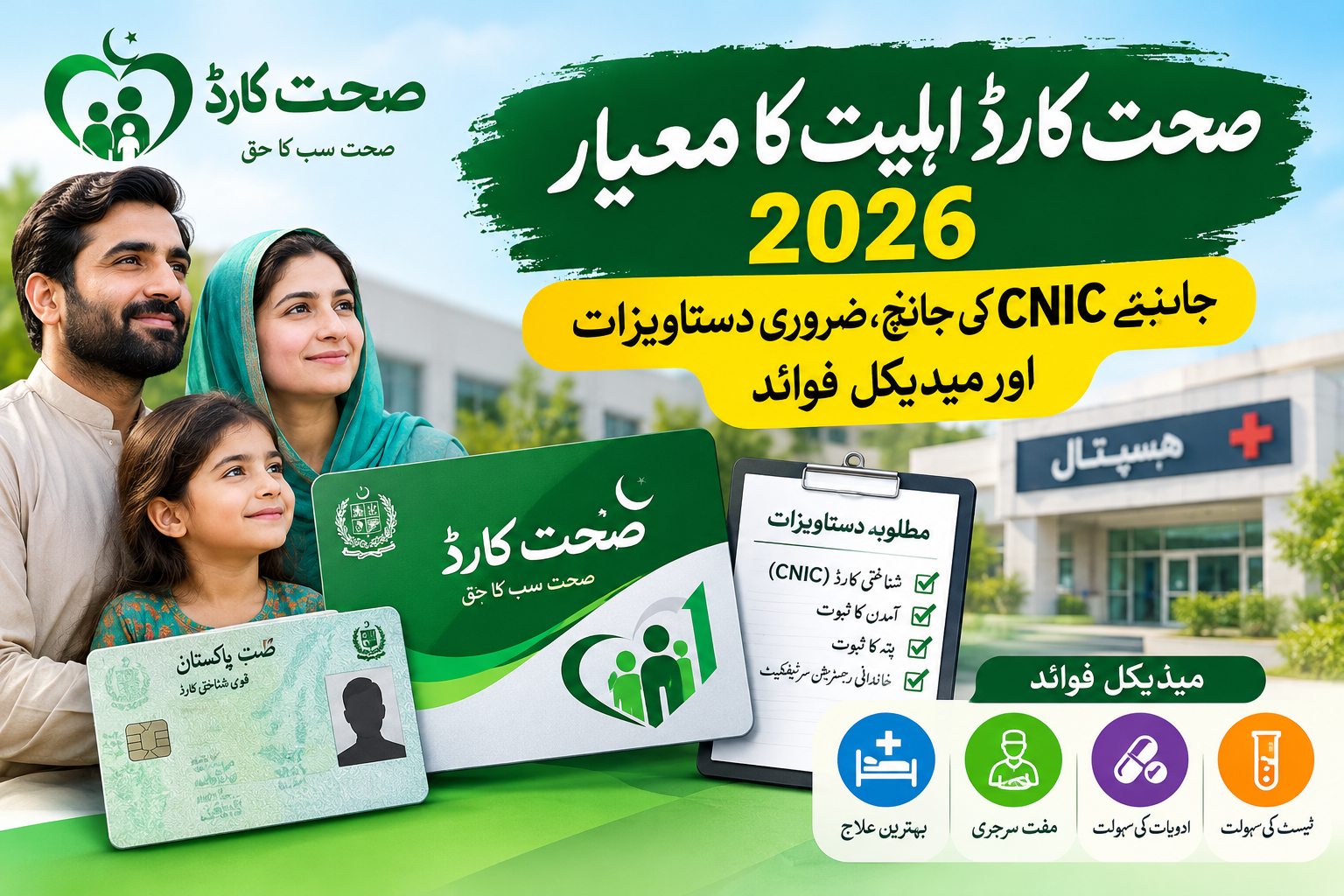
Sehat Card Eligibility Criteria 2026 – Check CNIC, Required Documents and Medical Benefits
The Sehat Card Program is a government healthcare initiative designed to help eligible families receive medical treatment without bearing the full financial burden of hospital expenses. It provides valuable support to families facing serious illnesses, medical emergencies, accidents, and costly surgical procedures.
However, eligibility requirements, medical coverage, and participating hospitals vary across different provinces of Pakistan. Residents of Punjab and Khyber Pakhtunkhwa should follow their respective provincial healthcare program guidelines. Meanwhile, people living in Sindh, Balochistan, and Islamabad should contact the relevant authorities to confirm which government healthcare facilities and insurance schemes are currently available.
Also Read: Wazir-e-Azam Apna Ghar Program 2026: Empowering Low-Income Families with Affordable Housing
Sehat Card Eligibility Criteria 2026
To qualify for Sehat Card benefits, applicants generally need to meet certain requirements related to their permanent residence, CNIC information, and family registration.
Before visiting a hospital, applicants should review the following basic eligibility requirements:
| Requirement | Details |
|---|---|
| Valid CNIC | Adults must have a valid NADRA-issued CNIC. |
| Permanent Residence | Applicants must satisfy the residency conditions of their provincial healthcare program. |
| Family Registration | Family information should be correctly registered with NADRA. |
| Children’s Identification | Children may require a B-Form or another accepted identification document. |
| Approved Hospital | Treatment must be received at a hospital registered with the relevant program. |
| Eligibility Verification | Coverage should be confirmed through the hospital or official program channels. |
These requirements provide general guidance. Actual eligibility depends on the rules, registration records, and coverage policies of the relevant provincial healthcare authority.
Who Can Benefit from the Sehat Card Program in 2026?
Sehat Card coverage is not identical throughout Pakistan. Each province may have different eligibility conditions, healthcare facilities, and treatment coverage.
1. Punjab Residents
Punjab operates a provincial Health Insurance Program through the Punjab Health Initiative Management Company (PHIMC).
According to the organization’s official information, permanent residents of Punjab can qualify for healthcare services under the applicable program conditions. Eligible individuals can use their original CNIC to seek treatment at participating private hospitals.
PHIMC provides information about approved private hospitals and available medical services. However, the availability of healthcare coverage in government hospitals has changed, so applicants should verify the latest arrangements before visiting a facility.
Residents are advised to check the updated hospital directory and treatment coverage through the official PHIMC website.
2. Khyber Pakhtunkhwa Residents
The Sehat Card Plus KP Program provides healthcare coverage to eligible permanent residents of Khyber Pakhtunkhwa.
According to the program’s official guidelines, applicants must have the required NADRA registration records. Adults generally need valid CNICs, while children under 18 may be required to provide their B-Forms.
Another important requirement is the permanent KP residential address recorded on the family head’s CNIC. If the system cannot verify an applicant’s information, the family should review its NADRA records and correct any missing details.
Eligible residents can contact the official Sehat Card Plus KP helpline for assistance with registration, eligibility verification, and hospital services.
3. Sindh, Balochistan and Islamabad Residents
Residents of Sindh, Balochistan, and Islamabad should understand that Sehat Card eligibility is not automatically the same across all regions.
Healthcare programs, insurance facilities, and government policies may differ depending on the area of residence.
People living in these regions should contact their provincial health department or the relevant government healthcare authority to find out whether an active health insurance or treatment assistance program is available.
Documents Required for Sehat Card Registration and Eligibility
Having the correct identification documents can make the eligibility verification process easier and help prevent unnecessary delays at hospitals.
Applicants should prepare the following documents where applicable:
- Original CNIC: Required for identity verification of adult patients.
- B-Form: Used to verify the identity and family registration of children.
- Updated NADRA Records: Family information should be accurate and up to date.
- Marriage Registration Details: May be required when updating a spouse’s family information.
- Additional Supporting Documents: Certain hospitals or healthcare programs may request further documentation.
Please remember that every applicant may not need all these documents. Requirements depend on the patient’s age, family registration status, and the applicable provincial program.
How to Check Sehat Card Eligibility in 2026
Applicants can verify their eligibility through the official healthcare program operating in their province.
Follow these steps to check your eligibility:
Step 1: Verify Your CNIC Information
First, make sure your CNIC is valid and your permanent residential address is correctly registered with NADRA.
Your family details should also be updated to avoid problems during the verification process.
Step 2: Use the Official Eligibility Verification Service
Residents of Khyber Pakhtunkhwa can check the published Sehat Card Plus eligibility method by sending their CNIC number through SMS to 9780. Applicants should confirm that the SMS service is currently operational before using it.
Punjab residents can visit the official PHIMC website or contact its helpline to obtain information about eligibility, medical coverage, and participating hospitals.
Step 3: Visit an Approved Hospital
After checking your eligibility, visit a hospital included in the relevant provincial healthcare program.
Bring your original CNIC and approach the hospital’s health facilitation desk. The staff can verify your eligibility and explain whether your required medical treatment is covered.
Step 4: Correct Any Missing NADRA Information
If your eligibility record cannot be found, check whether your CNIC, permanent address, or family registration information contains errors.
Visit your nearest NADRA office to update incorrect or incomplete information. After making the necessary corrections, contact the healthcare program or hospital again to request another eligibility check.
Sehat Card Benefits and Medical Coverage
The primary objective of the Sehat Card initiative is to make essential hospital treatment more affordable and accessible for eligible families.
Depending on the active provincial program and its coverage policy, medical benefits may include:
- Hospital admission and selected inpatient medical services.
- Emergency medical treatment covered under the program.
- Eligible surgical procedures and operations.
- Treatment for certain serious and long-term diseases.
- Selected heart-related procedures and cancer treatments.
- Covered medicines, laboratory investigations, and diagnostic services during hospital admission.
It is important to understand that not every medical procedure is automatically covered. Treatment limits, hospital participation, medical exclusions, and other conditions may apply.
Patients should confirm the availability of their required treatment with the hospital’s facilitation desk before proceeding.
Common Reasons Why Sehat Card Eligibility May Be Rejected
Some applicants experience difficulties accessing healthcare benefits even when they believe they meet the eligibility requirements.
Several factors can cause verification problems, including:
- Incorrect CNIC Details: Errors or outdated information in NADRA records can prevent successful verification.
- Incomplete Family Registration: Missing family members or outdated registration details may affect eligibility.
- Incorrect Residential Address: Applicants may not meet the permanent residence requirements of the program.
- Unrecognized Identity Record: A blocked or incomplete CNIC record can create verification issues.
- Non-Covered Medical Treatment: The requested procedure may not be included in the available healthcare benefits.
- Unapproved Hospital: Treatment at a hospital outside the approved network may not qualify for coverage.
- Program Restrictions: Coverage limits or other administrative conditions may affect access to benefits.
If your eligibility is rejected, ask the hospital’s health facilitation desk to explain the reason. Correct any identification or family registration issues and contact the relevant program helpline if the problem remains unresolved.
Official Sehat Card Websites and Helpline Numbers
For accurate eligibility information, applicants should use official government websites and verified contact channels rather than relying on unofficial sources.
Punjab Health Initiative Management Company (PHIMC)
- Website: https://phimc.punjab.gov.pk/
- Helpline: 0800-07542
Sehat Card Plus Khyber Pakhtunkhwa
- Website: https://sehatsahulat.com.pk/
- Helpline: 0800-89898
Applicants should verify the latest contact numbers, service availability, and eligibility-checking methods through the official websites before making inquiries.
Conclusion
The Sehat Card Eligibility Criteria 2026 depend on several factors, including provincial residence, valid CNIC information, family registration, and the policies of the active healthcare program.
Residents of Punjab and Khyber Pakhtunkhwa can check their eligibility through their respective provincial health authorities. People living in other regions should contact their local government departments to learn about available healthcare assistance and insurance facilities.
Keeping NADRA records updated, preparing the required identification documents, and selecting an approved hospital can help applicants avoid unnecessary difficulties.
Most importantly, always verify the latest eligibility conditions, treatment coverage, and hospital facilities through official government channels before relying on any advertised Sehat Card benefit.
Frequently Asked Questions (FAQs)
1. Who is eligible for the Sehat Card in 2026?
Eligibility depends on the rules of the relevant provincial healthcare program. Permanent residents of Punjab and eligible residents of Khyber Pakhtunkhwa should verify their CNIC and family records through the appropriate authorities.
2. Is a CNIC necessary to receive Sehat Card benefits?
Yes, adults generally need a valid CNIC for identity and eligibility verification. Children may need a B-Form or another identification document accepted by the relevant program.
3. How can I check my Sehat Card eligibility online?
You can visit your provincial healthcare program’s official website or contact its helpline. Residents of Khyber Pakhtunkhwa can also check the published SMS verification method by sending their CNIC number to 9780, subject to service availability.
4. Does the Sehat Card cover all medical treatments free of cost?
No. The program covers only those medical services and procedures included in its approved healthcare package. Treatment limits, exclusions, hospital network requirements, and other conditions may apply.
5. Is the Sehat Card available in every province of Pakistan?
Healthcare coverage and eligibility rules differ across Pakistan. Residents should contact their respective provincial health departments to confirm which government healthcare programs are currently operational.
6. What should I do if my Sehat Card eligibility is not verified?
First, check your CNIC and NADRA family registration details. If the information is incorrect or incomplete, visit a NADRA office for correction. You can then contact the relevant healthcare program or hospital facilitation desk for another verification attempt.